Source: @officialkrystalklear “When I think about what I have to do for my music to be heard it stops me from making the music I love.”
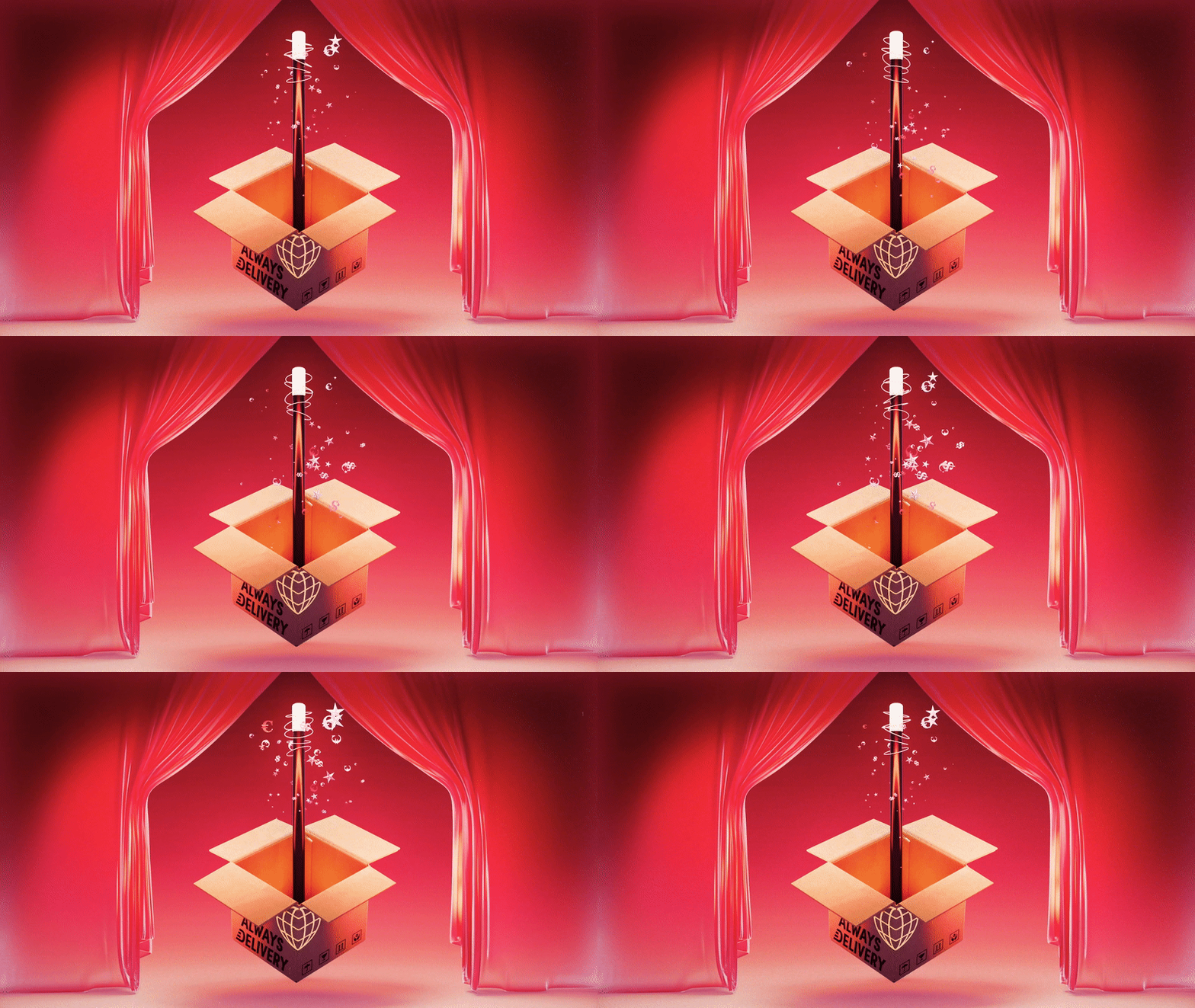
An exploration into the five magic tricks through which we become enthralled by modern commerce.
So much of our life has been and continues to be, shaped through online commerce. Half the time, it is miraculous; the other half, it is fleeting and overwhelming. In this essay, I compare our enigmatic relationship with eCommerce to the spectacle of a magic show, one that is staged together by the many "premiums" and online purchases we string on ourselves.
Our infatuation with and reliance on the magic of eCommerce is the premise of my research. To assess our relationship with online transactions and their magical effect, I conversed with consumers, creators, internet hustlers, business owners, and tech entrepreneurs. The outcomes of these conversations were then complemented with secondary research to give you the Magical Trilogy of eCommerce:
Part 1. eCommerce Tricks of Transformation
In this first part of the essay, I’ll investigate five magic tricks through which we become enthralled by modern commerce.
Part 2. When Tricks No Longer Treat
In the second part, I hypothesize how our love affair with magic commerce transforms our world at the individual, community, and societal levels.
Part 3. Must The Show Go On?
For the finale, I will share highlights from my conversations with innovators and critics about whether—and how—the current show of magic commerce can continue while reducing its havoc.
Part 1
If you asked me—and presumably, my fellow TikTok power users—what the soundtrack of growth and progress in 2022 was, I would point you to the bridge of AJR’s World's Smallest Violin. Often played as a soundtrack to Shorts, Reels, and TikTok videos about a creator’s growth or a business’ success journey, World’s Smallest Violin’s optimistic tempo and friendly hook make the perfect anthem to transforming through modern commerce.
Source: IMISTUDIOS, @imistudios
My first exposure to this song and its modern take on the rags-to-riches trope was through Imogen’s viral TikTok (above). Imogen is a fashion graduate turned business owner, designer, and TikTok creator. She started her made-to-order fashion brand, IMISTUDIOS, while staying at her parent’s during the pandemic. Her business gained traction through social media and landed significant brand collaborations, press mentions, pop-up events, and even caught the eyes of Doja Cat and Christine Quinn.
I chatted with Imogen about her experience buying, selling, and promoting her brand online. We discussed the physical and mental toll of simultaneously pleasing the audience and the algorithm. We then pondered over the fleeting nature of online communities and Imogen's reluctant reliance on social media to grow her business.
I asked,
"What three words would you use to describe your experience with online commerce?”
Imogen replied,
"Frustrating, rewarding, and transformative.”
It's frustrating because "you can spend so much time creating something you are proud of, and it can flop." It's rewarding because "when your content performs well, it does so in ways you can not even imagine." For the most part, it's transformative because "I'd not have my business today without TikTok and Instagram," said Imogen. It was through my conversation with her that the first trick of eCommerce began to take shape.
Trick 1
Artwork created in collaboration with Tim Straver
The hat trick is one of the most elemental acts of a magic show. During its performance, a magician keeps their audience's attention by placing in and pulling out different objects from the hat. One moment a rose is put inside, and the next moment, a dove flies out. The appeal of a hat trick lies in the discrepancy between what goes in and out of it. Similarly, online commerce encourages participation by manipulating the input and output between content creation and engagement metrics.
On the one hand, the increasing number of tools gives online business owners a sense of control by mastering content creation templates. On the other, the algorithm is an unpredictable factor, making it difficult to produce desired outcomes. In this constant flux between hopes and frustrations, small business owners are left with little choice but to constantly recalibrate and feed the algorithmic hat, hoping their next success will be an upload away.
While intangible in form, algorithmic mystery results in changes with tangible impact at cultural, community, and individual levels. At the cultural level, the algorithm reduces cultural diversity to formulaic and absolute common-denominated creations.
Most notably, music is increasingly optimized for algorithm-trained ears. Between 2000 and 2018, songs on the Billboard Hot 100 have reduced from 4 minutes-10 seconds to roughly 3 minutes-30 seconds. Lil Nas X’s Old Town Road which spent 17 weeks at No.1 on the Billboard Hot 100, clocks at 1 minute-53 seconds.
Adjacent to this development is the rise of interpolations and sped-up songs. When Steve Lacey’s music label asked if he wanted to put out a sped-up version of his song, Bad Habit for 69 cents, his response was: “Ew, that sounds fucking gross.“ But OK, sure – I’m No 2, and I want to be No 1, so go ahead.” In the age of modern commerce, culture first navigates around, then along the way, obeys algorithmic laws.
Source: @officialkrystalklear “When I think about what I have to do for my music to be heard it stops me from making the music I love.”
While social-graphed platforms like Instagram promote group building, interest-graphed algorithms decentralize relationships, prioritizing content display over creator advocacy. As a result, algorithmic commerce conflates following with fandom.
With over 1.4 million followers on TikTok and 2.5 million followers on Instagram, Grace Africa is a successful influencer by many measures. On September 2022, she organized a meet-and-greet as part of VidCon. Unfortunately, no one showed up at her event. A similar situation occurred with another beauty influencer, MsDarcei, while the enthusiasm for A-listed influencers like Charli D'Amelio also reportedly waned throughout the event.
Source: @grace_africa
A less-discussed but nonetheless potent way in which algorithms take hold of individuals' livelihoods is their tendency to cast prediction as precision. Last year, I spoke with Jason, a grocery delivery driver, about his job. Jason loves his job; delivering gives him a chance to rediscover his hometown and meet new people. However, Jason dreads his boss; in particular, his algorithmic boss. From delivery routes to delivery lengths, Jason's labor is directed by machine. Jason shared:
"Sometimes, the app doesn't know that there is a huge road reconstruction so its estimated time is so low. I often have to race against the clock to meet its required time and I’m still late. When that happened, I would get into trouble with my boss, and my customers wouldn’t be so kind with me either.”
— Jason, a grocery delivery driver.
In his book, 12 Inevitable Tech Forces That Will Shape Our Future, Kevin Kelly made a case for technology's tendency to cognify: imbuing inanimate objects with intelligence. In the same vein, it tends towards automating decisions and reducing outliers. Along the way of mirroring and giving us "For You" content, algorithmic commerce homogenizes our culture, fabricates fandom, and vacates our agency. But the show is not nearly over; for magic's power lies in the belief of its observers.
The algorithm's process of flattening intelligence requires both our willingness and conviction to take place. It means we can still take back control or even radicalize our relationship with algorithms. Taking a step back from algorithmic dependency might mean a step back from sudden fame and a step back from quantity-driven creation and consumption. And perhaps most difficultly, it is a step back from convenience. It also means taking a leap of faith in new creatives, a step towards deliberation, and a step towards connecting through difficult conversations; not just entertaining or joyous content.
Trick 2
Artwork created in collaboration with Tim Straver
It was 2016 in China. The country had recently renounced its one-child policy. After 36 years plagued with the systemic abortion of female fetuses, China was left with a population of mainly single men (namely guanggun or ‘bare branches’). The country was on the move. More and more women migrated from their hometowns to metropolises in search of economic opportunities. Lonely men, in abundance, remained in their hometowns and found connection through a new form of online commerce: live-streaming.

Source: YY Live
By sending "virtual gifts," these guanggun gained intimate views into female streamers' daily lives. When the gift was considerable enough, live streamers would perform more elaborate acts in return, such as singing or dancing. Some also famously carried out extreme acts, such as chugging entire bottles of alcohol or eating maggots. Today, live commerce is estimated to reach 4.9 trillion yuan (~$723B) in China by 2023.
While the need for connection ignited China’s adoption of live-streaming, its origin also hinted at a mechanic that amplifies its power; it is its granted ability for streaming audiences to assert their will against time, space, and others: the ability to telepath.
"’Freddie, Freddie, it's your turn, what do you want?’ My name was called up in a live-stream with over 4,000 people from all over the world. Here I am living in this small town. I felt like I was a celebrity. From thousands of miles away, I felt like I was there, in front of everyone and it was my turn to spin the wheel."
— Freddie, a research participant.
Freddie is a university student who is based in a small town in the UK. In our conversation, Freddie introduced me to the #picknmix trend. This trend is where buyers order random assortments of candy via live-streams. In the case of Freddie, during a #picknmix live-stream, Freddie made an order and was asked to spin a wheel of fortune to receive giveaways. Freddie, a self-proclaimed low-key and reserved person, told me he was amazed at how much his brief “celebrity” moment boosted his morale.

Source: Tempting Sweets
In marrying streaming technology with sellers' ingenious trove of interactive formats, live shopping enables audiences like Freddie to not only enter someone else's space but also purchase their way into altering their reality. Freddie’s story is also consistent with Klarna's recent study which cites real-time interaction, intimate views of sellers, and reality-show-entertainment quality as some of the main benefits of live shopping.
Live streaming isn't the only way in which telepathy-commerce comes to life. Sometimes the need to transact despite physical constraint truly necessitates. When speaking with Zamina, an Uzbek who lives in Germany, I learned about a thriving Telegram marketplace managed by Kyrgyzs and Uzbeks living abroad. Zamina works in retail at a fast fashion brand. In addition to her job, Zamina runs several Telegram groups where she receives requests from other Uzbeks to visit fashion stores to take photos of or try on clothes for buyers back home. After each visit, Zamina packages a shipment for all orders, applies her employee discount (when appropriate), ships the clothes back, and makes a profit.
Regardless of the technology, the stories of Zamina, Freddie, and "Guanggun" demonstrate the need and attraction to commerce that help transcend people through space. They also evidence the growing view of consumption as a means to gain control over and assert influence on others. While feeling better through shopping is nothing new (#shoppingtherapy), the performance of controlling and altering others' reality heightens, for the worse, when it is broadcasted and financially rewarded by the internet.
Source: Rest of World. Chinese influencers in Africa often stream videos of their employees showing appreciation for getting money, presents, or even food.
In a story on the rise of China's live-commerce boom, Rest of World reported hours of racist and misogynistic content produced by Chinese streamers who live in countries like Guinea, Tanzania, Zambia, Mozambique, and Kenya. During these streams, Chinese influencers often portray themselves as wealthy saviors while degrading women as sexual objects and teaching kids to say racial slurs in Chinese.
According to tracking service Bihukankan, in a 4.5-hour streaming session of this trope, Cheng Wei—a Zambia-based Chinese vlogger—sold about $22,000 worth of T-shirts, facial wipes, and watches.
Source: Rest of World: “Part of China’s live-streaming eCommerce boom, experts say, was built on top of hours of racist and misogynistic content.”
This is not just a story of fame-seeking and money-hungry influencers; it's a story about how our desire to gain superior status and financial rewards online can come at the expense of others. If the "guanggun" were only looking for connection, asking female streamers to eat maggots seems incongruous. When asked why he streamed this content to the world, Cheng Wei said: “Chinese people love watching how other places are not as good as China. If you film some advanced stuff here, people might not like watching. They would rather see lives that are worse than their own.”
Trick 3
Artwork created in collaboration with Tim Straver
Crucial to a magic show’s persuasion is the presence of assistants. From dancing to being sawed in half, magicians’ assistants are both an ornamentation and a means of misdirection. On the stage of eCommerce, influencers and creators play this assisting role. As living props, they give form to goods and validate their promises.
An illustrative example of this symbiosis is Shein's relationship with their growing base of influencers. Founded in 2016, Shein is a Chinese real-time fashion eCommerce company. In 2020, it reported $10 billion in revenue and had grown over 100% for each of the previous eight years. Between mid-Feb and mid-May 2021, Shein ranked second in the iOS App Store, only after Amazon for shopping apps in the United States.
Combining a vertically integrated supply chain, exploitative labor practices, and real-time data analytics, Shein offers thousands of garments at unbeatable prices daily. Their infinite scroll of cheap and on-trend looks gives influencers the ability to transform and display that magic en masse; via ‘Shein hauls.’
Source: mmynamesmillicent69
Shein haul content often depicts their creators unboxing and trying on orders ranging from $400, $800, and even up to $2000; each features hundreds of items. Through these haul videos, creators approximate their audience's transformation through their own, bridging the gap between imagination and manifestation.
While hauls aren't new, the ease of creating their content is. In the past, becoming a fashion influencer often required brand endorsement or upfront costs. Today, influencers can afford more outfits, and they are also given more free garments in exchange for their unpaid labor. The massive amount of clothes obtained at Shein price (~$5+) and speed (10,000 new products a day) also point to the fact that hauls have always been about the sport of consumption and never about clothing.
In the age of analytic-informed-faster-than-fast fashion, clothing and hauls are becoming more accessible, while fashion itself trends towards plagiarism and disposability.

Source: @noorieana - “My Zara hauls on YouTube would perform really well so I felt somewhat obliged to continue buying a lot so that I could do a haul. I realized that I was buying more for the sake of creating content…”
But influencers don't just haul because they can; they do so because the internet craves haul content. While destructive to the environment, haul content often garners hundreds of thousands, if not millions, of views on TikTok, Instagram, or YouTube. Hauls are so quintessential to the influencing industry that they are seen as today's influencers' rite of passage. In an interview with Fashion North, a style and beauty journalism platform, influencer Demi Donnelly shared:
“I have always continued to do my hauls because it’s where I started, and it’s what people want to see… If I go a few weeks without a haul, people constantly comment, ‘when is your next clothing haul’?
Why is haul content so popular among climate-conscious Gen-Zers?
Although price is a driving factor, it is not the only explanation for the internet's love of haul videos, especially considering their three-digit price tags. Two potential reasons found in my research are Gen Z’s brewing annihilation view and their dissociation from creators.
Annihilation
Annihilation promotes the idea that nothing matters since the world itself is coming to an end. Given our deteriorating environment and increasing inequality worldwide, this view has gained much more popularity in recent years. An effect of this idea is that it encourages inaction through false equivalence.
"A lot of other companies use children to do their clothes too," said TikTok user Taiksu in defense of Shein critics. While A and B can both be harmful, one can also be worse. The thriving annihilistic view on the internet has created a convenient argument to excuse bad acts like haul content from scrutiny.
Dissociation from creators
Celebrities of the 2000s are often idolized or judged against their premise of being role models. Creators today, especially haul creators, are at times reductively characterized as mannequins for online window shopping. Seven out of ten consumers whom I spoke with didn't see their "subscribed to" creators as someone whose relationship they valued.
"I know these creators and influencers are here to get money from me or their following numbers. I'm their customer and their boss, so as long as I get what I want from them, I don't care what they have to say about other things.”
— A paid Substack member expressed their relationship with their creator.
In a strange turn of events, the magic assistants end up being consumed by the very magic they sell. Today, creators are recognized as business entities, human filters, or mere mirrors. Their humanity is reduced to whether their body can be a good "size reference" or whether they come with promotional codes or giveaways. Creators' eroding sense of humanity in the eyes of their viewers enables consumers to exclude them from our shared world; and in doing so, mentally excuse them from their questionable haul content.
“It's not that they care about Emma Chamberlain's coffee. Emma knows nothing about coffee. These girls buy Chamberlain coffee beans because they want to be Emma.”
— An influencer explained why creators buy Chamberlain coffee.
You need a success story to sell anything, including becoming successful influencers like Emma Chamberlain or Charli D'Amelio. Charli D'Amelio is a US teenage girl who found her fame through dancing TikTok videos. Emma Chamberlain started her career as a relatable girl who spoke openly about her depression. She became famous with her series of one-dollar store haul videos. Charli now sells fragrances, owns a clothing line, and even has a reality show on Hulu. Emma runs a coffee company, appeared on The Tonight Show With Jimmy Fallon, and even hosted the red-carpet interviews at the Met Gala.
As leaders of the modern QVC trade, the successful minority among creators validate the transformative power of assisting online commerce. They subsequently productize their transformation into downloadable tips or shoppable commodities. These commodities have little to do with their intrinsic value but everything to do with the magical narrative their creators tout.
To induce mass consumption, online commerce must facilitate mass demonstration of its magic. It needs humans to provide social proof and invoke loss aversion among consumers.
Together, eCommerce and their assistants create an ecosystem where buyers are entertained by user-generated content while buying into the transformative promises of both the goods and the influencing career. But perhaps unbeknownst to the assistants, this commercial system also strips away their humanity, reducing their creativity and community to the logic of virality and monetization.
Trick 4
Artwork created in collaboration with Tim Straver
Fundamental to the art of magic is the materialization of objects out of the immaterial. Our fascination with producing things at will recently make a cultural comeback through the resurgence of "manifesting." Google searches for "manifesting" skyrocketed 669% from March to mid-July 2020 and have continued to trend upward as of writing. The hashtag #manifestation currently has more than 27 billion views on TikTok and 8.5 million posts on Instagram.

Source: trends.google.com. Interest over time on the search team “manifesting.”
Today, "manifesting" is part of the thriving "mystical and psychic services industry," with a market size of $2.2 billion. High-profile gurus and entrepreneurs offer a wide range of manifesting goods and services, including apps, consulting hours, and online courses.

Source: Statista. Market size of the psychic services industry in the US (in a million U.S. dollars)
Rooted in the New Age's pseudoscientific Law of Attraction, "manifesting," as a belief, promises human agency against the ongoing talks of despair and uncertainty. In the 19th century, means of manifestation mainly related to the spiritual practices of vision boarding, dream journaling, or positive affirmation. Manifesting in the age of online commerce has found a modern accomplice: same-, next-, or two-day delivery. Like picking a coin from thin air, fast delivery gives consumers the magician's ability to manifest their desires in a matter of days, hours, or even minutes.
In February 2005, Amazon Prime launched its "all-you-can-eat express shipping" program, providing subscribers with unlimited two-day deliveries. Since then, delivery times have been reduced to less than a day and even same-day delivery in some areas. Along this trend are similar “instant manifestation” developments, such as Getir's on-demand delivery in 2015, ASOS Instant in 2017, and Gorillas, a 10-minute grocery delivery service valued at $3.1 billion in 2020. In just under two decades, accelerated by the pandemic, our world has become ever more reliant on express shipping: according to Shopify, 60% of global consumers expect same-, next-, or two-day delivery, while Statista forecasts same-day-delivery market size to reach 26.4 billion U.S. dollars in 2027.
This infatuation with—and arguably addiction to—instant manifestation brings forward two forms of social depreciation. First is the removal of human deliberation, and second is labor abstraction. To understand how instant manifestation wanes deliberation, let's take a page out of the manifestation playbook and imagine:
Imagine your name is Carla. You are 19 years old, living in a dorm with your friends, and studying Psychology. You care about the environment, and you shop deliberately. In the past few days, you noticed the same patterned green dress called Hockney showing up all over your TikTok and Instagram. Kendall Jenner wears it. Your followed arts-and-craft creator wears it. Your cousin wears it. You don’t think you need it.
On a night out, while waiting in the Burger King line, you saw an ad from ASOS featuring the Hockney. “I have ASOS Instant. I can have this delivered for free tomorrow!” you thought. You bought the dress. That night, you went out, had fun, and forgot about the purchase. The next morning, you woke to a knock on your door. "Package for Carla," said the delivery courier. You opened the package to reveal the Hockney dress you saw on the internet. The same dress you had just seen the day before online. It was now in front of you. Feeling half amazed and half guilty, you were nonetheless excited to put it on.
Congratulations, Carla. You manifested.
This story of Carla is based on a true conversation I had with Hannah, a Psychology student. In her story, instant commerce and manifestation offer both the functional benefit of a timely acquisition and the emotional thrill of manifesting, all while making buying decisions a reflex.
"I usually do research before I purchase anything, and I rarely buy new items. Ever since I signed up for ASOS Instant last Christmas, I have become a bit addicted to shopping. There is something special about the convenience and the magic of it all. I'm still amazed every time something arrives to me the next day. I think I'm going to cancel it this year."
— Hannah, a research participant.
While the emotional reward of next-day delivery feels magical, the human terms and conditions bound to its spell are anything but. This irony brings up discussions about the labor behind manifesting magic.
After the local newspaper where she reported closed, Emily Guendelsberger—the author of On the Clock: What Low Wage Work Did to Me and How It Drives America Insane—took a job at an Amazon fulfillment center. In her book, Emily shares that Amazon required her to work nights, weekends, holidays, and overtime on "immediate demand" without notice. She chronicles stories of families, husbands, and wives whose shifts tail one another’s, leaving them with seconds to pass each other on a Monday night.
The just-in-time economy requires an all-the-time labor force. For this reason, things don't just manifest. More often than not, they are delivered at human costs. Costs that are conveniently abstracted through "human-centered" user interfaces and swallowed in magical narratives. This asymmetrical relationship between those who buy magic and those who deliver it underpins what Grafton Tanner—author of The Hours Have Lost Their Clock: The Politics of Nostalgia—described as the userverse.
Userverse is a "surrogate world" that gives its users a sense of “unchallenged mastery” over, and at the expense of, others. It is a pretense where users "can enjoy being served while reassuring themselves… that no one is being harmed as if their feeling of domination just flows naturally from the technology itself and not the social relations it is masking."
In pairing the spiritual allure of manifesting ideology with technology-masqueraded human labor, modern commerce further dissociates the middle class from the working class. It deepens our reliance on "Amazon-fulfilled" goods for self-fulfillment.
Trick 5
Artwork created in collaboration with Tim Straver
While trying on hundreds of Shein outfits boasts endless possibilities, stacked boxes of hardly worn clothes brings their climate footprints and our physical finiteness on stage. No appearing coin act is complete without its vanishing counterpart. eCommerce’s magic show, too, needs a disappearing act to sustain its glamor… introducing re-commerce.
Re-commerce refers to the selling and buying of previously owned products. In this final segment of magic commerce, “re-commerce” doubles as both a climate hero and a consumption enabler. While promoting “reusing” and “recycling,” re-commerce platforms like Depop and Vinted can also inadvertently help drain the residue of overconsumption and dispose buyers’ of their guilt.
To pulse-check this claim, I quickly searched for the 15 most loved brands by Gen-Z on Depop USA. Of the 15 brands mentioned, Shein is ranked as the 9th most loved brand but simultaneously has the 3rd most listings on Depop as of writing, just after Nike and Adidas.
While some Nike and Adidas items are an asset class, the proliferation of Shein on the secondhand market is better explained by its trend-based overproduction. In her interview with The Atlantic, fashion influencer Tricia Panlaqui also cited Depop as one of her main ways to get rid of clothes when she has more garments than she knows what to do with—this sentiment echos in my primary research.

Source: Primary research. Of the 10 most beloved brands by GenZ (according to YPulse), Shein has the third most listing on Depop USA as of February 5th, 2023.
This enabling relationship between re-commerce and overconsumption is also discussed in Jennifer Le Zotte’s book From Goodwill to Grunge: A History of Secondhand Styles and Alternative Economies. There she wrote, “The impetus to get rid of clothing is often charitable, but the more clothing that is contributed and viable, the more fashion cycles speed up.”
While sometimes, romanticized as a business that operates above the wheel of consumption, re-commerce can still operate within the logic of buying trends. This paradoxical nature can be seen in how resale platforms use the language of social media to promote trend-driven transactions. Like Instagram, Depop features a content feed which allows shoppers to explore trends and top sellers. Similar to Twitter, top sellers on Depop earn a blue check mark which gives them algorithmic favor.
To maintain this status, these sellers must also relate to trends in their listings. On Depop, an old jumper is an "Emo alt grunge dark Academia skater goth Vintage y2k Argyle Sweater," while a pair of old jeans is a "Vintage low rise black jeans with pink rhinestones y2k 2000s miss sixty morgan bella hadid dkny baby phat 90s mall goth.”

Listing Image Source: Depop
It is important to acknowledge that resale platforms and re-commerce at large are a positive development. However, to reach their full potential, we must recognize how these platforms' success can sometimes hinge on the tropes of hopping through trends and hiding their waste.
A way in which tech-enabled commerce puts waste out of our sight and mind is through products that promise renewal without decay. Last year, Pela, the company that produces biodegradable phone cases, announced the launch of the Lomi Composter. According to their website, Lomi can turn anything from food scraps to their iPhone cases into plant-friendly dirt. “Impress your friends! Lomi makes your food waste disappear in under four hours. Can you say magic?” the Lomi website stated.

Source: Lomi
For those who can afford up to $549, Lomi and their 2-year supply of filters and Pods provide the illusion of saving the planet and reducing footprints without facing the stench of their consumption or investing time in regenerative composting. Reviews from a soil scientist and a published gardener have pointed out false and misleading claims from Lomi around its climate footprint and whether its dirt is truly soil-friendly. Lomi themselves explained that two of their three types of dirt still belong in the trash, a green bin, or a compost pile. They are waste.
While Lomi's vanishing trick works wonders in sparking the imagination of change, it does little to transform the world where we truly need it. As poignantly criticized by journalist Tynan Stewart, Lomi—and, or similar tech promises—“dilute the radical potential of reorganizing society so that it works with natural systems rather than attempting to dominate or subvert them.” The point of composting is to force one to slow down and participate in a cycle of transformation that is set by the organic process of decay, not the demands of profit.”
While seemingly a magical proposition, products like Lomi or re-commerce technologies can overlook an important truth: consumption produces waste, and regardless of its smell or visibility, waste is still waste. If we, as consumers, will not learn to confront our waste and recognize its lasting life, we will not stop conveniently shopping; and magically wasting.
eCommerce Tricks of Transformation is the first part of the Magical Trilogy of eCommerce. It discusses five magic tricks that eCommerce uses to capture our attention and participation:
Trick 1: The Mysterious Hat of Algorithm
Along the way of mirroring and giving us "For You" content, algorithmic commerce tends towards a flattening of culture, conflating followings with fandom, casting prediction as precision, and, to a growing extent, removing human agency.
Trick 2: The Telepathic Trick of TeleCommerce
TeleCommerce enables consumers to enter someone else's space and purchase their way into altering their reality. While gaining status and control through shopping isn't new, the way we financially reward the broadcast of everything is worthy of further scrutiny and investigation.
Trick 3: The Magician’s Assistant
eCommerce and its assistants (influencers and creators) create an ecosystem where buyers can be entertained while buying into the promises of goods and the influencing career. This system can sometimes reduce creativity and community to the logic of virality and monetization.
Trick 4: The Next-Day Manifestation
In pairing the spiritual allure of manifesting ideology with labor-masking technology like next-day delivery, modern commerce dissociates the middle class from the working class and deepens our reliance on "Amazon-fulfilled" goods for self-fulfillment.
Trick 5: The Vanishing Waste of eCommerce
While seemingly a magical proposition, products and services that put our overconsumption waste out of sight can overlook an important truth: waste is waste, regardless of smell or visibility. If we do not learn to confront our waste, we will not learn to stop magically wasting.
Coming up next
Like a magic show whose power comes from novelty, eCommerce thrives in its induced and constant pursuit of newness, leaving behind lasting—albeit imperceptible—identity-related, cultural, and societal impacts. In the second part of this trilogy, titled When Tricks No Longer Treat, I will discuss how the five tricks of transformation collectively influence our life in three ways:
Look out for Part 2 in the coming months.